Why the Highveld Gets Hit by So Much Lightning
If you’ve lived in Johannesburg, you know the routine. The morning is clear and blue, the heat builds through lunch, and around 3pm the sky turns the colour of a bruise. Within the hour, the city is being lit up. It isn’t your imagination: the Highveld is one of the most lightning-prone regions in the world.
What makes the Highveld so prone
Almost every summer afternoon, three things line up over Gauteng.
Altitude
Johannesburg sits at around 1,750 m above sea level. Storm clouds that form here are already closer to the cold, high levels of the atmosphere where ice forms, and ice is what makes lightning.
Heat
The sun bakes the ground all morning. The hot air near the surface rises fast, building towering cumulonimbus clouds in a matter of hours.
Moisture
Humid air flows in from the Indian Ocean and feeds those clouds, giving them the fuel to grow into serious storms.
How lightning forms
Inside a storm cloud, powerful updrafts throw ice crystals and small hailstones around. They collide constantly, and each collision transfers a little electric charge. Lighter crystals carry positive charge to the top of the cloud, while heavier hail carries negative charge to the bottom.
Eventually, the difference between cloud and ground gets so large that air, normally an insulator, gives way. A channel of charge forges its way down, meets another rising up from the ground, and the circuit completes. That flash is the lightning.
The heat of a lightning bolt
A single bolt heats the air around it to roughly 30,000°C, about five times hotter than the surface of the sun. The air expands outwards faster than the speed of sound, and that shockwave is thunder.
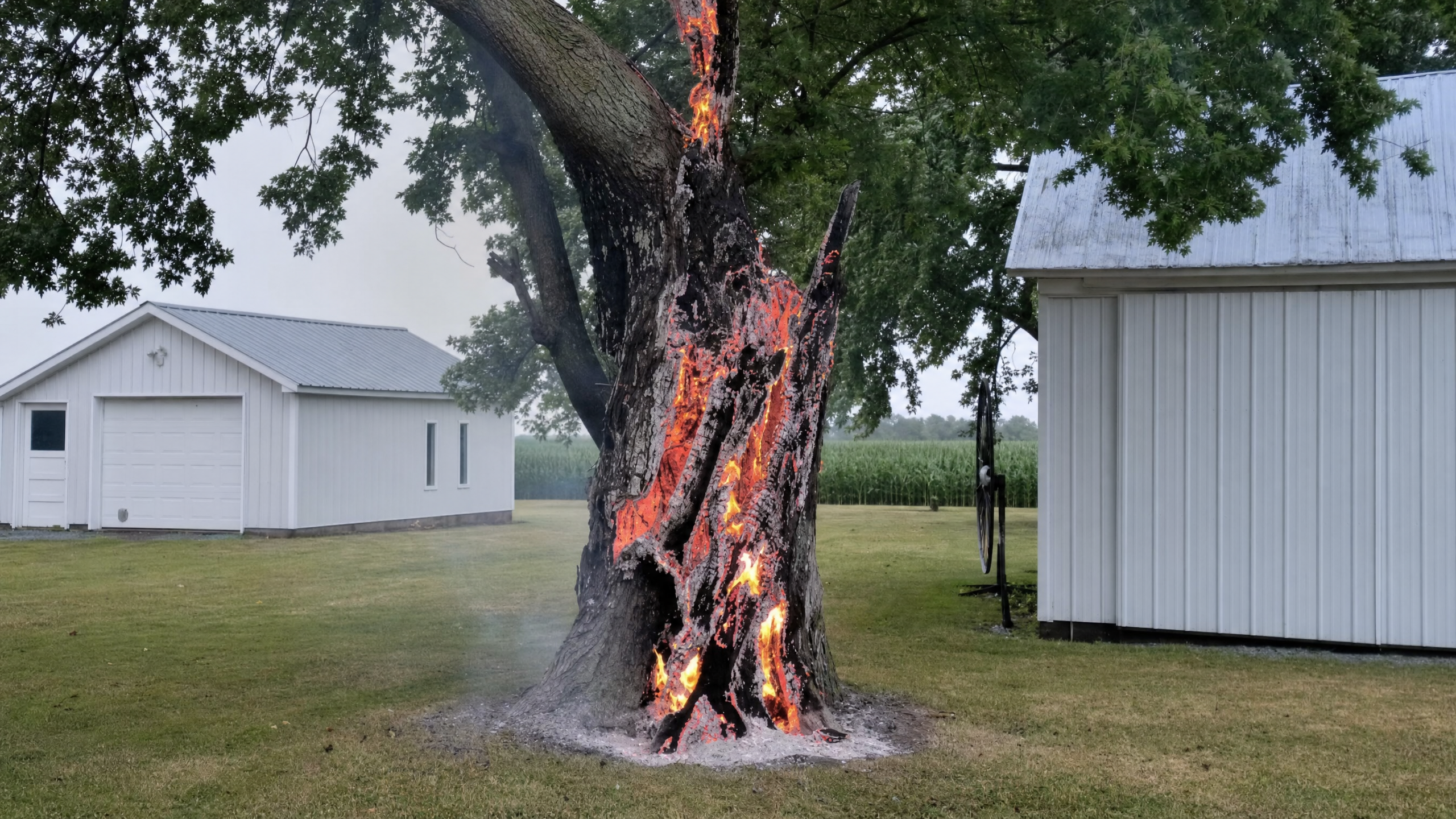
What a direct lightning strike can do to a tree
Strikes away from the storm
Lightning can travel 10 to 15 km from the storm that produced it, which is why people are sometimes struck under a patch of blue sky. These are known as “bolts from the blue”. The simple rule is that if you can hear thunder, you are close enough to be hit.
Judging the distance
Count the seconds between the flash and the bang, then divide by three. That’s the distance in kilometres. The standard safety guideline is the 30-30 rule: if the gap is 30 seconds or less, take shelter, and wait 30 minutes after the last thunder before heading back out.
Why the season starts in October
Late October is when the season ramps up. The ground has been hot and dry for months, so the first big storms of summer tend to be the most dramatic. Expect plenty of afternoons like this one between now and March.
Staying safe
Get into a building or a hard-topped vehicle, not under a tree.
Stay away from windows, plumbing and corded appliances during a storm.
Unplug electronics or use surge protection. Lightning damage to routers and TVs is common on the Highveld.
Don’t swim, and get off open ground, sports fields and hilltops.