South Africa's Dams: Mid-Winter Water Storage Update
South Africa's major dams remain in a healthy position this winter, with Western Cape reservoirs steadily filling while inland systems stay near capacity.
South Africa's water reserves are in a strong position as we reach the middle of winter. While the country's rainfall patterns differ significantly between regions, most major dams are sitting at healthy levels thanks to abundant summer rainfall in the interior and a steady start to the Western Cape's winter rainfall season. Although the outlook is positive, there is still plenty of winter left, particularly for the Cape, where additional cold fronts are needed to maximize water storage before summer.
Major Dam Levels
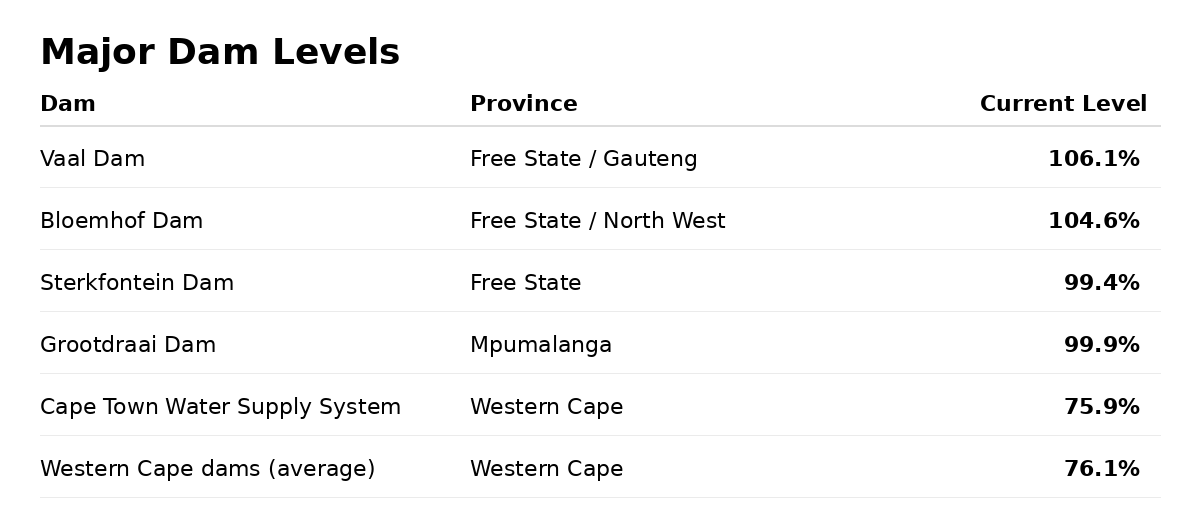
The Integrated Vaal River System, which supplies Gauteng and large parts of the Free State, North West and Mpumalanga, continues to perform exceptionally well. The Vaal Dam remains above its full supply capacity at 106.1%, while Bloemhof Dam sits at **104.6%. **Sterkfontein Dam, South Africa's largest reservoir by storage capacity, remains virtually full at 99.4%, providing an important strategic reserve for the country's most populated region.
Further east, Grootdraai Dam is also in excellent condition at 99.9%, highlighting the strong water security across much of the inland summer rainfall region following the wet 2025/26 rainfall season. These dams typically receive very little inflow during winter, so maintaining such high storage levels provides confidence heading into the warmer months.
The picture is slightly different in the Western Cape, where winter is the primary rainfall season. Recent cold fronts have steadily boosted dam levels, with the Cape Town Water Supply System climbing to 75.9%, while the provincial average stands at 76.1%. These figures are encouraging for this stage of winter, but several more meaningful rainfall events will be needed before spring to ensure reservoirs approach full capacity ahead of next summer.
Although dam levels are generally healthy nationwide, rainfall has been uneven. Some catchments have received below-average rainfall this winter, while others have benefited from repeated frontal systems. Water experts continue to encourage responsible water use, reminding South Africans that healthy dam levels today do not eliminate the risk of future droughts, particularly in a country where rainfall is naturally variable.
Looking ahead, additional cold fronts are expected to continue moving across the southwestern parts of the country during the remainder of winter. If these systems produce widespread rainfall over the major catchments, dam levels in the Western Cape should continue to improve through July and August, while inland reservoirs are expected to remain stable until the summer rainfall season begins later in the year.