Antarctica Gained 695 Billion Tonnes of Ice. How Is That Possible in a Warming World?
Antarctica gained 695 billion tonnes of mass between 2021 and 2023. Here's how tropical ocean warming, atmospheric circulation and exceptional snowfall caused the temporary increase despite long-term ice loss.
Antarctica has a bit of a reputation for being the place where climate change should be easiest to understand. The planet warms, ice melts, sea levels rise. Simple, right?
Well, not quite.
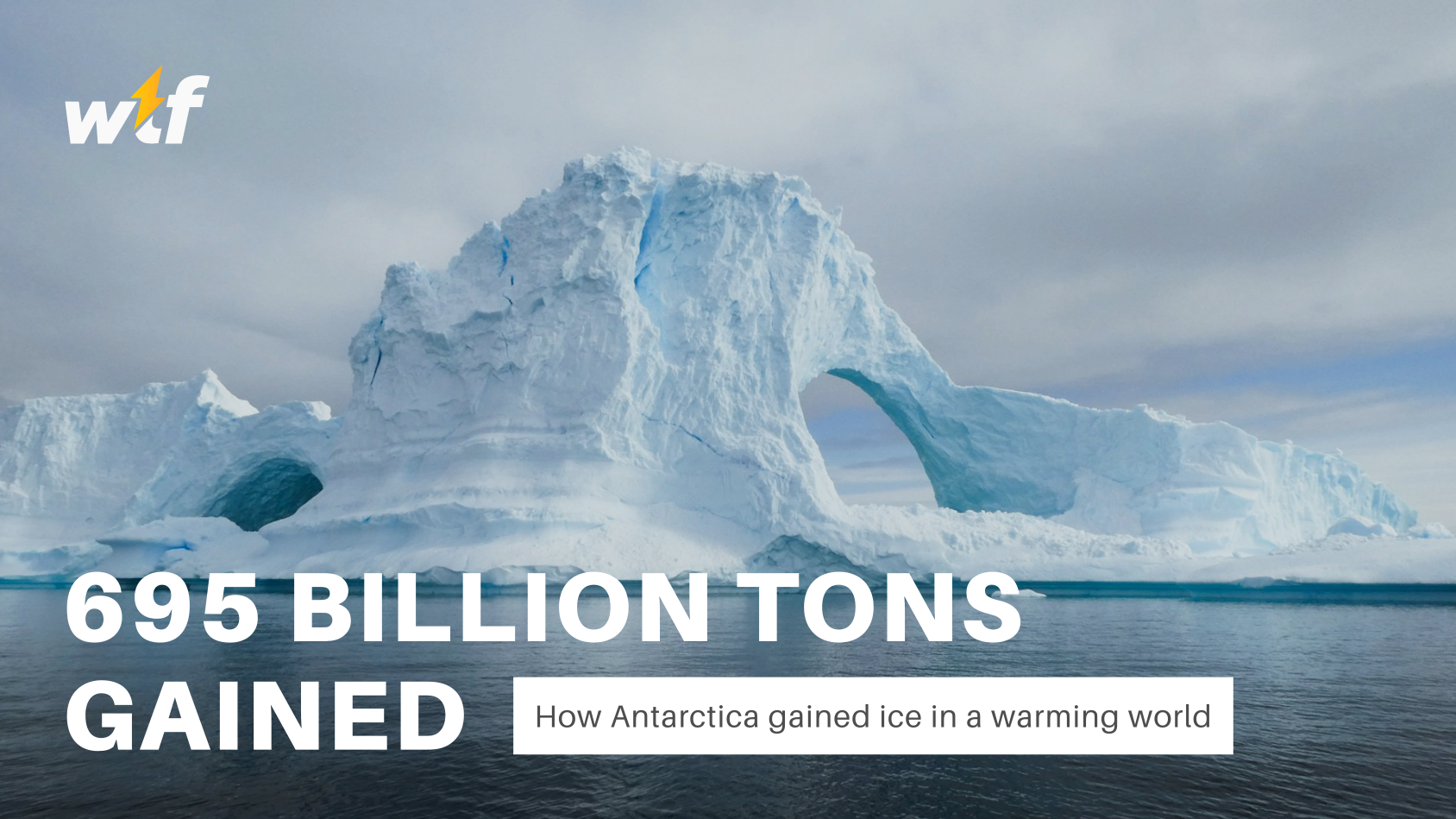
Scientists have discovered that the Antarctic Ice Sheet gained an astonishing 695 billion tonnes of mass between July 2021 and April 2023. That sounds like it should be impossible in a warming world, particularly when we have spent years hearing about Antarctica's accelerating ice loss.
But there is no contradiction here. The new research reveals a fascinating example of how interconnected Earth's climate system really is, with weather patterns thousands of kilometres away playing a major role in what happened at the bottom of the world.
The increase was largely caused by an extraordinary amount of snowfall across parts of East Antarctica. And behind that snowfall was an unusual chain of events that began with persistent warming in the tropical oceans.
Antarctica's ice balance is a numbers game
Before getting into what caused the sudden increase, it helps to understand how scientists think about Antarctica's ice sheet.
Antarctica is constantly gaining and losing mass. Snow falls onto the continent and adds to the ice sheet, while glaciers slowly carry ice towards the coast and eventually into the ocean. Ice shelves can also lose mass through melting, particularly from relatively warm seawater underneath them.
The overall Antarctic ice balance depends on which of those processes wins out.
During most of the satellite record, the losses have been greater than the gains. But between July 2021 and April 2023, something unusual happened. The amount of snow accumulating across parts of East Antarctica became so large that it temporarily outweighed the ice being lost elsewhere.
According to the new study published in Nature, Antarctica gained around 695 billion tonnes of mass during those 22 months, making it the largest 22-month mass-gain event recorded by the GRACE satellite mission.
Importantly, that gain wasn't spread evenly across the continent. Around 470 billion tonnes of the increase occurred across Queen Mary Land and Wilkes Land in East Antarctica, while other regions, particularly West Antarctica, continued to lose ice.
So Antarctica wasn't suddenly gaining ice everywhere. Instead, an enormous increase in snowfall in one part of the continent temporarily tipped the overall balance.
The surprising part happened thousands of kilometres away
The obvious question is why it snowed so much.
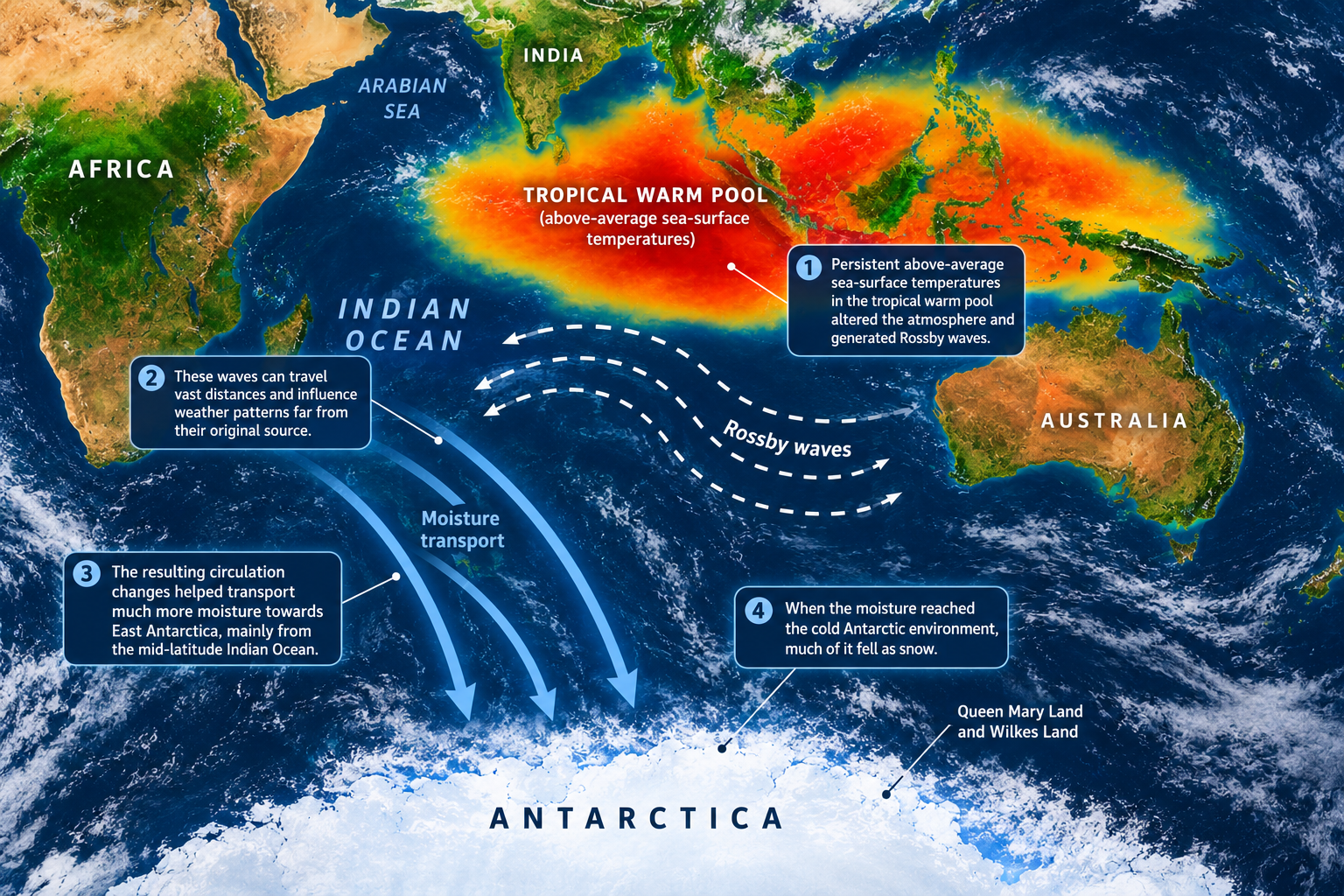
The researchers found that the answer can be traced back to unusually persistent warming in the tropical warm pool, a huge region of warm ocean stretching across the western Pacific and eastern Indian Ocean.
During 2021 to 2023, this region experienced persistent above-average sea-surface temperatures. That tropical warming altered the atmosphere above it and generated large-scale atmospheric waves known as Rossby waves.
These waves can travel vast distances and influence weather patterns far from their original source. In this case, the resulting circulation changes helped create conditions that transported much more moisture towards East Antarctica.
That moisture came largely from the mid-latitude Indian Ocean before being carried towards the continent. Once it reached the cold Antarctic environment, much of it fell as snow.
The result was an extraordinary period of snowfall over Queen Mary Land and Wilkes Land.
Essentially, warm tropical oceans helped rearrange the atmosphere, and the atmosphere then delivered an enormous amount of water to Antarctica in the form of snow.
It is a pretty remarkable example of how something happening in the tropics can eventually affect conditions thousands of kilometres away.
But wasn't the planet warming?
This is where the story gets particularly interesting.
It would be tempting to look at the result and conclude that global warming caused Antarctica to gain ice. But the researchers found that the situation was more complicated than that.
Their modelling suggests that human-caused climate change contributed only a relatively small part of the unusual precipitation increase during the event. In the Queen Mary Land–Wilkes Land region, the anthropogenic contribution (climate change caused by human activities) was estimated at around 9% of the precipitation anomaly.
The researchers instead linked most of the exceptional snowfall to natural variability associated with the persistent tropical warm-pool warming and the atmospheric circulation it produced.
That doesn't mean global warming is irrelevant to Antarctic snowfall. In fact, a warmer atmosphere can hold more moisture, which can potentially increase snowfall over parts of Antarctica.
What it means is that the enormous snowfall event of 2021–2023 appears to have been driven primarily by a particular pattern of natural climate variability rather than being a straightforward consequence of human-caused warming.
The distinction is important because climate change doesn't make every individual weather event behave in the same direction.
A warmer atmosphere can actually mean more Antarctic snow
Antarctica presents a particularly interesting climate paradox because warming can potentially increase both snowfall and ice loss.
The reason is that warmer air can hold more moisture. If that additional moisture is transported over Antarctica, where temperatures remain cold enough, it can fall as snow.
At the same time, warming oceans can increase melting beneath vulnerable ice shelves around the continent. If those ice shelves thin, the glaciers behind them can flow more rapidly towards the ocean.
So a warming climate can potentially put more water onto the Antarctic Ice Sheet from above while also increasing the amount of ice leaving it around the edges.
That means scientists can't simply look at snowfall and decide whether Antarctica is gaining or losing ice. They need to measure the entire mass balance.
And that balance can change considerably from year to year.
Antarctica is still losing ice overall
This is probably the most important context behind the 695-billion-tonne figure.
The recent increase does not mean Antarctica has reversed decades of ice loss.
A major assessment published in 2026 found that Antarctica lost approximately 4,780 billion tonnes of ice between 1979 and 2023, contributing around 13.3 millimetres to global sea-level rise.
The enormous snowfall event between 2021 and 2023 temporarily interrupted that longer-term decline, but it did not erase the ice losses that came before it.
And while parts of East Antarctica were gaining mass, other areas continued to lose it.
West Antarctica remains particularly important because several glaciers there are losing ice rapidly, with relatively warm ocean water contributing to melting beneath floating ice shelves. As these ice shelves weaken, the glaciers feeding them can lose some of the resistance that slows their movement towards the ocean.
In other words, Antarctica can quite literally be gaining hundreds of billions of tonnes of snow in one region while losing enormous quantities of ice somewhere else at the same time.
Atmospheric rivers are part of the story too
The unusual snowfall isn't only about one particular atmospheric circulation event.
Other recent research has also highlighted the role of atmospheric rivers, which are long, narrow corridors of concentrated moisture that can transport huge quantities of water vapour through the atmosphere.
When these systems reach Antarctica, they can produce intense snowfall and rapidly add mass to the ice sheet.
Research published in 2026 found that increased atmospheric-river activity contributed to recent snowfall gains in parts of Antarctica, helping offset continuing losses from ice flowing into the ocean.
This is another reminder that Antarctic ice isn't controlled by one simple process. Snowfall, atmospheric circulation, ocean temperatures, glacier movement and ice-shelf melting are all interacting with one another.
So has Antarctica's ice loss been reversed?
No, at least not based on this event.
The 695-billion-tonne increase is better understood as a temporary interruption of a much longer-term trend.
The tropical conditions responsible for the exceptional snowfall are part of natural climate variability, and similar periods of persistent tropical warm-pool warming have occurred before. There is no indication from this study that Antarctica has suddenly entered a new era of sustained ice growth.
Instead, the event shows how dramatically Antarctica's short-term ice balance can be affected by changes in atmospheric circulation.
For a couple of years, the amount of snow falling over parts of East Antarctica was simply enormous.
That extra snow was enough to outweigh ice losses elsewhere and produce a net increase across the continent.
But once those atmospheric conditions changed, the balance shifted again.
Antarctica's ice story is more complicated than the headline suggests
The 695-billion-tonne figure is therefore both surprising and completely compatible with what scientists know about a warming planet.
Antarctica can gain mass temporarily because of exceptional snowfall while still experiencing long-term ice loss. Those two things aren't mutually exclusive.
Think of the ice sheet as an enormous bank account. Snowfall is money being deposited, while glaciers flowing into the ocean and melting are withdrawals. During 2021–2023, the deposits in parts of East Antarctica were unusually large. For a while, they were big enough to outweigh the withdrawals.
That doesn't mean the withdrawals have stopped.
In fact, the bigger climate question is what happens over much longer periods. A single year, or even a couple of years, can look very different from a trend measured over several decades.
And that's why scientists rely so heavily on satellites and long-term observations. They allow researchers to separate unusual weather and natural climate variability from persistent changes in the climate system.
The Antarctic Ice Sheet is not simply responding to a warmer planet by getting smaller everywhere at the same time. It is responding to a constantly changing combination of atmospheric circulation, snowfall, ocean temperatures, glacier dynamics and ice-shelf processes.
The surprising part of this latest discovery is therefore not that global warming has somehow stopped Antarctica from losing ice.
It's that a warming world can still produce periods where Antarctica gains an enormous amount of mass, because sometimes the weather thousands of kilometres away has a very big say in what happens at the bottom of the world.