El Niño Could Contribute to 451,000 Additional Deaths
A new report from the University of Chicago's Climate Impact Lab estimates that extreme heat linked to the developing El Niño could contribute to 451,000 additional deaths worldwide by February 2027. Researchers warn that the greatest impacts are expected in vulnerable regions, where limited access to cooling and healthcare could increase the risks.
A powerful El Niño developing in the Pacific could contribute to approximately 451,000 additional deaths worldwide by February 2027, according to a new projection from the University of Chicago's Climate Impact Lab.
The estimate, released on 23 September, covers the period from June 2026 to February 2027. It represents deaths above what would normally be expected during an average year, not a confirmed death toll.
The researchers estimate that around 239,000 additional heat-related deaths could occur between September 2026 and February 2027 alone. They warn the figure could rise if unusually warm conditions continue into 2027.
Why is El Niño raising concerns?
The current El Niño is developing against a backdrop of long-term global warming. The Climate Impact Lab estimates global land temperatures could average around 1.2°C above normal during the coming months, with the number of extremely hot days increasing by approximately 44% compared with a normal year.
Researchers say the combination of natural El Niño variability and a warmer global climate can increase the risk from extreme heat.
Which regions could be affected most?
The impacts are expected to vary significantly between regions.
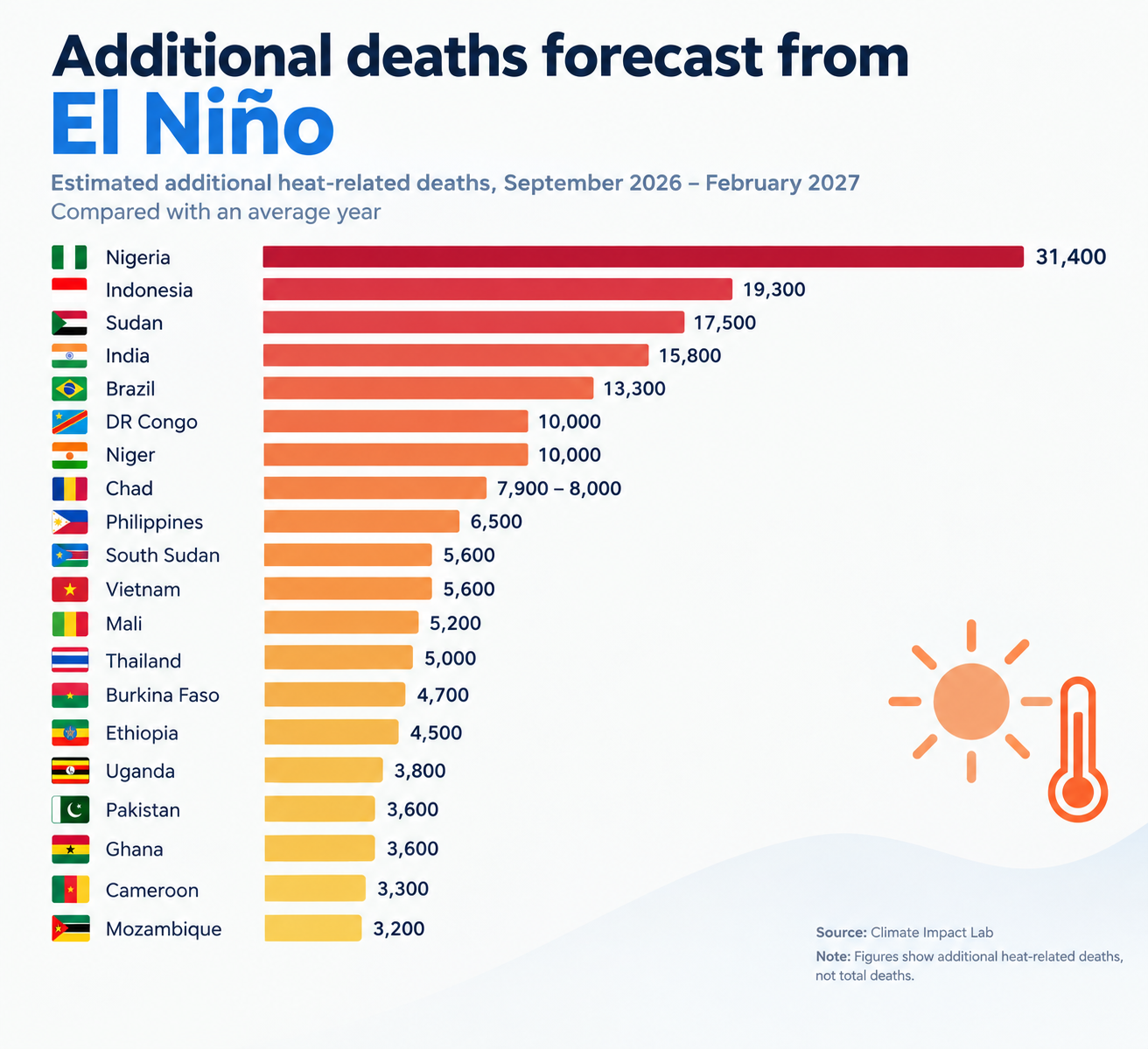
The Climate Impact Lab projects some of the largest increases in heat-related deaths across the African Sahel, Southeast Asia, India and Brazil.
The Sahel alone could see approximately 66,800 additional heat-related deaths between September 2026 and February 2027, including around 31,400 in Nigeria.
Across parts of Southeast Asia, the report estimates approximately 19,400 additional deaths in the Philippines, Vietnam, Thailand and Cambodia combined, with another 19,300 projected in Indonesia.
Why is extreme heat so dangerous?
Extreme heat places significant strain on the body. Prolonged exposure can cause dehydration, heat exhaustion and potentially fatal heatstroke, while also increasing stress on the cardiovascular and respiratory systems.
Older adults, young children, outdoor workers and people without access to cool indoor spaces can face greater risks.
Heat-related deaths can also be difficult to measure because extreme temperatures can worsen existing medical conditions without being recorded as the direct cause of death.

How was the estimate calculated?
Researchers combined seasonal temperature forecasts with historical data on the relationship between temperature and mortality.
The analysis covers 24,378 regions worldwide and compares projected deaths during the current El Niño with those expected during an average year, using 1996 to 2025 as the baseline.
The researchers also accounted for uncertainty in their forecasts and mortality estimates.
The 451,000 figure is therefore a projection, not a prediction of a confirmed number of deaths. The eventual impact will depend on how temperatures develop.
Can the impacts be reduced?
Researchers say many heat-related deaths can potentially be prevented through measures such as early-warning systems, cooling centres, hydration stations, healthcare outreach and better protection for outdoor workers.
The report estimates that targeted action could prevent tens of thousands of deaths during the current El Niño period.

The event also highlights a broader concern:
El Niño is occurring in a world that is already significantly warmer than it was in the past. The researchers say temperatures experienced during this event could resemble conditions that climate models suggest may become more common in the future.
As El Niño develops, its effects on global temperatures and human health will continue to be closely monitored.